A lot of matcha is being sold in India right now. Some of it is excellent. A lot of it is not what the label says it is.
The term “ceremonial grade” has no legal definition. Any brand can print it on any packet. Which means the only way to know if what you have is genuinely ceremonial grade is to know what to look for yourself.
Here are five signs that tell you immediately whether your matcha is the real thing or something dressed up to look like it.
Sign 1: The Colour Is Yellow or Dull Green
Genuine ceremonial grade matcha is a vivid, deep emerald green. If your matcha looks yellow, olive, or dull, it is not ceremonial grade. Colour is the single most reliable visual indicator of matcha quality and directly reflects the shade-growing period and chlorophyll concentration in the leaf.
Shade-growing is what makes ceremonial grade matcha green. When the Camellia sinensis plant is covered for 20-30 days before harvest, it produces significantly more chlorophyll and L-theanine as it reaches for light. That chlorophyll is what gives premium matcha its characteristic deep green colour.
Low-grade matcha skips or shortens this step. The result is a yellow or brownish-green powder that looks nothing like what you see in a Japanese café.
The fix is simple. Open your matcha, hold a small amount up to natural light. If it is not a vivid, almost jewel-like green, the grade is not what it claims to be.
Understanding what is matcha made of explains exactly why the shade-growing and stone-grinding process determines what ends up in your cup.
Sign 2: It Tastes Bitter Straight in Water
Genuine ceremonial grade matcha prepared at the correct water temperature (70-80°C) should have no bitterness. A clean umami sweetness with a smooth finish is the baseline. If your matcha is bitter, astringent, or harsh in plain water, it is either low grade, over-processed, or prepared with water that is too hot.
Bitterness in matcha comes from two places: catechin oxidation in low-grade leaves, and tannins released when boiling water is used. Ceremonial grade matcha has a naturally higher L-theanine to catechin ratio, which produces sweetness rather than bitterness.
The quick test: whisk half a teaspoon in 70ml of water at 75°C. No sweetener. If it is unpleasant to drink straight, the grade is the problem.
One caveat: if your water is too hot, even good matcha will turn bitter. Test at 75°C before writing off your matcha entirely. But if the bitterness persists at the right temperature, the matcha itself is the issue.
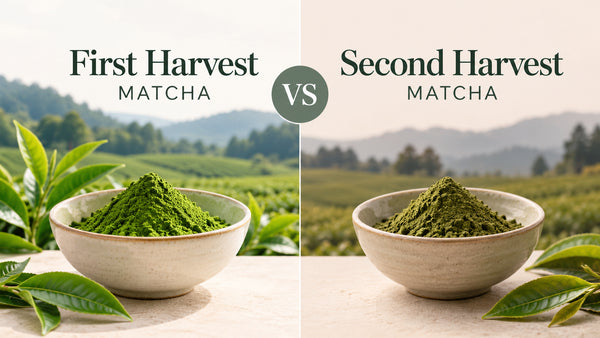
The harvest matters enormously here. First harvest vs second harvest matcha explains why first flush leaves carry the highest L-theanine concentration and the lowest bitterness.
Sign 3: The Texture Is Gritty or Coarse
Ceremonial grade matcha is stone-ground to a particle size of 5-10 microns, finer than talcum powder. It should feel completely smooth between your fingers with zero grittiness. Any coarse texture indicates either low-grade matcha or ball-mill processing, which produces uneven particle sizes and inferior flavour.
This one is easy to check right now. Rub a small pinch of your matcha between your thumb and forefinger. Ceremonial grade disappears into the skin, leaving a slight green stain. Low-grade matcha feels like fine sand.
Particle size is not just about texture. Finer grinding means more surface area, which means more of the EGCG, L-theanine, and chlorophyll in the leaf is bioavailable when you drink it. Coarsely ground matcha delivers less of everything that makes matcha worth drinking.
Genuine stone milling produces approximately 30 grams of matcha per hour at 30-60 RPM. It is slow, expensive, and the only method that consistently achieves the particle fineness ceremonial grade requires. Most cheap matcha is ball-milled in minutes.
If you are questioning what you currently have, best matcha powder in India from CHÃ Wellness is stone-ground, first or second harvest, and the difference is immediately apparent in both texture and cup.
Sign 4: The Origin Is Vague or Missing
Genuine ceremonial grade matcha always comes from a specific, named region in Japan. If the packaging says only “Japanese matcha” or “green tea powder” with no region, farm, or cultivar information, treat it as a red flag. Transparent sourcing is a baseline expectation for any brand selling ceremonial grade.
Japan has several distinct matcha-growing regions: Uji in Kyoto, Shizuoka, Nishio in Aichi, Yame in Fukuoka, Kagoshima. Each has a different flavour profile, different cultivation tradition, and different quality reputation.
A brand that cannot tell you where their matcha comes from either does not know, or knows and does not want you to know. Neither is acceptable when you are paying ceremonial grade prices.
Look for region, harvest season, and ideally cultivar on the label. If those three things are present, the brand is at least trying to be transparent. If the label says “premium ceremonial grade” with nothing else, walk away.
How to identify genuine yame matcha covers what region-specific authenticity looks like for one of Japan’s most prized growing areas.
Sign 5: It Goes Stale Fast or Smells Flat
Fresh ceremonial grade matcha has a clean, grassy, slightly sweet aroma that is immediately recognisable. If your matcha smells flat, musty, or like dried grass, it has either oxidised due to poor packaging or was low quality to begin with. Nitrogen-flushed, airtight packaging is the only reliable way to preserve matcha from Japan to your cup.
Matcha oxidises the moment it is exposed to air, light, or heat. The chlorophyll breaks down, the L-theanine degrades, and what was ceremonial grade becomes something far closer to culinary grade within weeks of poor storage.
The smell test is instant. Open a fresh sachet of genuine ceremonial grade matcha and the aroma is clean, vegetal, and slightly sweet. It smells alive. Oxidised or low-grade matcha smells like old green tea or nothing at all.
This is why packaging matters as much as sourcing. Nitrogen-flushed airtight sachets are the standard for any matcha brand serious about delivering the same quality that left Japan. Without it, even good matcha deteriorates in transit.
For everything you need to know about keeping your matcha at peak quality after opening, how to store matcha powder covers the full protocol.
And if you want a reference point for what genuinely fresh, authentic ceremonial grade looks, smells, and tastes like, authentic Japanese matcha powder is worth reading before your next purchase.

CHÃ WELLNESS · JAPANESE MATCHA
Discover AAA Matcha
Smooth, refined and approachable. Discover second-harvest Japanese matcha from Shizuoka.
SHOP NOWWhat Genuine Ceremonial Grade Actually Looks Like
Here is the complete picture in one place:
|
Ceremonial Grade AAA |
Low Grade / Fake Ceremonial |
|
|
Colour |
Deep emerald green |
Yellow, olive, dull green |
|
Taste |
Smooth umami, no bitterness |
Bitter, harsh, astringent |
|
Texture |
Silky, 5-10 micron particle size |
Gritty, coarse, uneven |
|
Origin |
Named region, harvest, cultivar |
Vague, “Japanese matcha” only |
|
Aroma |
Fresh, grassy, slightly sweet |
Flat, musty, old green tea |
|
Packaging |
Nitrogen-flushed, airtight |
Standard pouch or tin |
|
Certification |
FSSAI, tested at origin |
No third-party certification |
CHÃ Wellness sources Ceremonial Grade AAA matcha across five cultivars from Uji Kyoto and Shizuoka, Japan. Every batch is first or second harvest, stone-ground, nitrogen-flushed, and FSSAI certified. The team visited farms directly in Japan, tasted over 12 varieties, and selected only what cleared every standard on this list.
Explore the full range of ceremonial grade matcha India and see exactly what genuine ceremonial grade looks, smells, and tastes like.
Frequently Asked Questions
How do I know if my matcha is ceremonial grade?
Check five things: colour (deep emerald green), taste (smooth with no bitterness at 75°C water), texture (silky, not gritty), origin (named Japanese region and harvest), and aroma (fresh and grassy). If your matcha fails any of these, it is likely not genuine ceremonial grade regardless of what the label says.
What colour should ceremonial grade matcha be?
Ceremonial grade matcha should be a vivid, deep emerald green. Yellow, olive, or dull green colour indicates low chlorophyll content from insufficient shade-growing, which is a reliable sign of lower grade matcha.
Why does my matcha taste bitter?
Bitterness in matcha comes from either low-grade leaves with high catechin to L-theanine ratio, or water that is too hot. Test at 75°C first. If bitterness persists at the correct temperature, the matcha itself is not ceremonial grade.
What does fake matcha look like?
Fake or low-grade matcha sold as ceremonial grade typically looks yellow or olive green, tastes bitter in water, feels gritty between the fingers, has no specific origin information on the label, and has a flat or musty aroma. Any one of these signs is a red flag. All five together means what you have is not ceremonial grade.
Where can I buy genuine ceremonial grade matcha in India?
CHÃ Wellness sources ceremonial grade matcha AAA directly from Japan, with full origin transparency, FSSAI certification, and nitrogen-flushed packaging. Five cultivars from Uji Kyoto and Shizuoka are available at chawellness.in.